
When you apply for a Vietnam e-visa, one question always comes up: single entry or multiple entry?
It sounds simple. But choosing the wrong one is a real, costly mistake. A single entry visa becomes void the moment you leave Vietnam, regardless of how many days remain. If your plans shift, even briefly, you’re locked out and starting a new application from scratch.
This guide breaks down exactly what each option means, what it costs, and which one fits different types of trips. By the end, you’ll know which to choose without second-guessing yourself.
What’s the Actual Difference?
A Vietnam e-visa is issued by the Vietnam Immigration Department and is valid for up to 90 days. Both the single entry and multiple entry versions share that same 90-day window. The difference is what happens when you leave Vietnam.
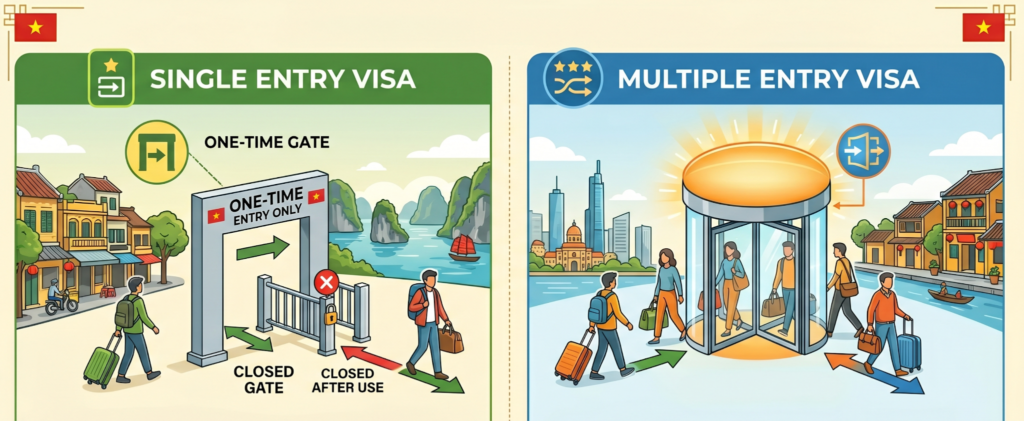
- With a single entry e-visa, you are permitted to enter Vietnam once. The moment you cross the border to exit, the visa is void. It doesn’t matter if you still have 60 days of validity left. That entry has been used, and the visa cannot be reactivated.
- With a multiple entry e-visa, you can exit and re-enter Vietnam as many times as you want within the 90-day validity period. Every time you return, your visa is still active.
One common point of confusion: Domestic flights between Vietnamese cities do not count as an exit. Flying from Hanoi to Ho Chi Minh City or from Da Nang to Phu Quoc keeps you inside Vietnam. Single entry is sufficient for those trips. You only need multiple entry if your plans include crossing an international border.
Single vs Multiple Entry Vietnam E-Visa: At a Glance
| Feature | Single Entry (90 Days) | Multiple Entry (90 Days) |
| Entries allowed | One | Unlimited within validity |
| What happens if you exit | Visa becomes void immediately | Visa remains active; re-entry allowed |
| Government fee | USD $25 | USD $50 |
| Ideal traveler | Visiting Vietnam only, no border crossings | Multi-country itineraries, digital nomads, business travelers |
| Border run flexibility | None, new application required to return | Full, leave and return via any approved checkpoint |
| First port rule | Entry must match port listed on visa | First entry must match listed port; subsequent entries can use any of 83 approved checkpoints |
| Document rejection cost | USD $25 non-refundable if rejected | USD $50 non-refundable if rejected |
Not sure which visa to choose? Contact us
When Single Entry Is the Right Choice
A single entry e-visa is the right option when your trip is straightforward: you enter Vietnam, you stay, and you leave once at the end.
It works well for:
- First-time visitors on a direct trip to Vietnam with no regional side trips planned
- Short-stay travelers attending a conference, family event, or business meeting inside Vietnam
- Budget-conscious travelers who are certain their itinerary won’t cross a border
- Travelers moving between Vietnamese cities by domestic flight or bus, with no international exit
The key word is certainty. If your plans are fixed and you know you will not leave Vietnam during your stay, single entry covers you completely at a lower upfront cost.
Pro Tip: Even one loosely planned day trip to Phnom Penh or Siem Reap voids a single entry visa the moment you cross into Cambodia. If there’s any chance of a side trip, read the next section before deciding.
When Multiple Entry Makes Sense
Multiple entry is the smarter choice any time your trip includes crossing out of Vietnam, even briefly.
Common scenarios where multiple entry is needed:
- Indochina circuit travelers combining Vietnam with Cambodia, Laos, or Thailand on a single trip
- Digital nomads or slow travelers using Vietnam as a home base while taking regional weekend trips
- Business travelers with cross-border meetings or clients in neighboring countries
- Travelers on Southeast Asia cruises that dock at multiple countries and return to Vietnamese ports
- Anyone planning even one international day trip, visa run, or side journey out of Vietnam
The multiple entry visa turns Vietnam into a genuine regional base. You can exit to Siem Reap, Bangkok, or Luang Prabang and return to Vietnam without filing a new application or paying another government fee.
Important: Your first entry into Vietnam must be through the port listed on your visa application. After that initial stamp, subsequent entries can be made through any of Vietnam’s 83 approved international checkpoints, including airports, land border crossings, and sea ports.
What Does Each Option Cost?
The government fees set by the Vietnam Immigration Department are straightforward:
| Visa Type | Government Fee | Validity |
| Single Entry | USD $25 | Up to 90 days, one entry |
| Multiple Entry | USD $50 | Up to 90 days, unlimited entries |
Both fees are non-refundable. If your application is rejected by the Vietnam Immigration Department for any reason, the government fee is not returned. There’s also a cost logic worth noting: if you book a single entry visa and then need to re-enter Vietnam after an unplanned exit, you’ll pay $25 again for a new application. For anyone with even moderate travel flexibility, the $50 multiple entry option is often cheaper than applying twice.
Common Mistakes When Choosing (and Applying)
Most application errors are avoidable. These are the ones that come up most often:
Choosing single entry when your plans are flexible
This is the most common misjudgment. Travelers book a single entry visa assuming their trip is straightforward, then add a weekend trip to Cambodia mid-journey. The result is a voided visa and a fresh application under time pressure.
Applying for a second e-visa while the first is still active (Very Important)
Vietnam’s immigration system flags this as a conflict. Submitting a new application before your current one has expired or been used can result in both visas being suspended. If you need to switch from single to multiple entry, wait until your current visa expires or complete your existing trip first.
Date format errors
Vietnam uses DD/MM/YYYY. Travelers from the US and some other countries are accustomed to MM/DD/YYYY. Entering the month and day in the wrong order is one of the most common reasons travelers are denied boarding at the airport. Double-check every date field before submitting.
Name mismatches with your passport MRZ
Your name on the e-visa application must match the Machine Readable Zone (MRZ) at the bottom of your passport bio page, not just how your name appears in everyday use. If your middle name, suffix, or hyphenated surname appears in the MRZ, it must be on the visa exactly as written there.
Skipping a final review before submission
Once your application is submitted, errors cannot be corrected on the same file. A human review step before submission catches these details before they become a problem. evisas vietnam’s team runs an 8-step logic check on every application to catch typos, date format issues, and document quality problems before the file reaches the Vietnam Immigration Department.

Frequently Asked Questions
Does a domestic flight between Vietnamese cities count as an exit?
No. Flying between Hanoi, Da Nang, Ho Chi Minh City, Phu Quoc, or any other domestic destination is not an international exit. You remain inside Vietnam. A single entry visa covers all domestic travel within the country.
Can I upgrade from single entry to multiple entry after I’ve applied?
No. Once an application is submitted, the entry type cannot be changed. You would need to submit a new application for a multiple entry e-visa. If your existing single entry visa is still active, applying for a new one while it’s live can cause system conflicts, so it’s worth getting the right type from the start.
Can I hold two active Vietnam e-visas at the same time?
No. The Vietnam Immigration Department does not permit two active e-visas linked to the same passport. Attempting to do so can result in both being suspended. Apply for one visa at a time.
What happens if I leave Vietnam on a single entry visa by accident?
Your single entry visa becomes void immediately upon exit, regardless of the remaining validity days. You’ll need to submit a full new application and pay the government fee again before you can re-enter. This is why it’s worth considering the multiple entry option if there’s any uncertainty in your plans.
What port of entry should I list for a multiple entry visa?
List the port where you plan to make your first entry into Vietnam. After that initial stamp, you are free to enter and exit through any of Vietnam’s 83 approved international checkpoints for all subsequent crossings.
Is the government fee refundable if my application is rejected?
No. The Vietnam Immigration Department does not refund government fees if an application is refused. This applies to both single entry ($25) and multiple entry ($50) applications. Accuracy on the initial submission matters.
Further Reading
If you want to go deeper on related topics before you apply, these articles from the evisas vietnam blog cover the ground most travelers find useful:
- Vietnam’s 90-Day Multiple Entry E-Visa: How Does It Work? – A full breakdown of how unlimited re-entries work, the first port rule, hard boundaries, and common pitfalls specific to the multiple entry visa.
- Vietnam E-Visa: The Complete Guide (2026 Update) – Covers everything from eligibility and document requirements to processing times and what to check before you submit.
- Vietnam Visa on Arrival vs. E-Visa (2026): Which Is Better for Your Trip? – Useful if you haven’t fully settled on the e-visa route and want to compare your entry options side by side.
Choosing the Right Visa Before You Apply
For most straightforward holidays, single entry is sufficient. For anyone with a flexible itinerary, a multi-country route, or any chance of leaving Vietnam during their stay, multiple entry is the safer and often more cost-effective choice.
evisas vietnam’s team reviews every application before it’s submitted to help travelers avoid the most common mistakes. Whether you’ve already decided on single or multiple entry, or you’re still weighing the options, you can start your application at the link below.
All e-visas are issued by the Vietnam Immigration Department, evisas vietnam provides application support and expert review as a private consultancy.
Ready to get your e-visa now? Apply here