Planning to visit Vietnam with an e-visa? One detail you should not overlook is your port of entry.
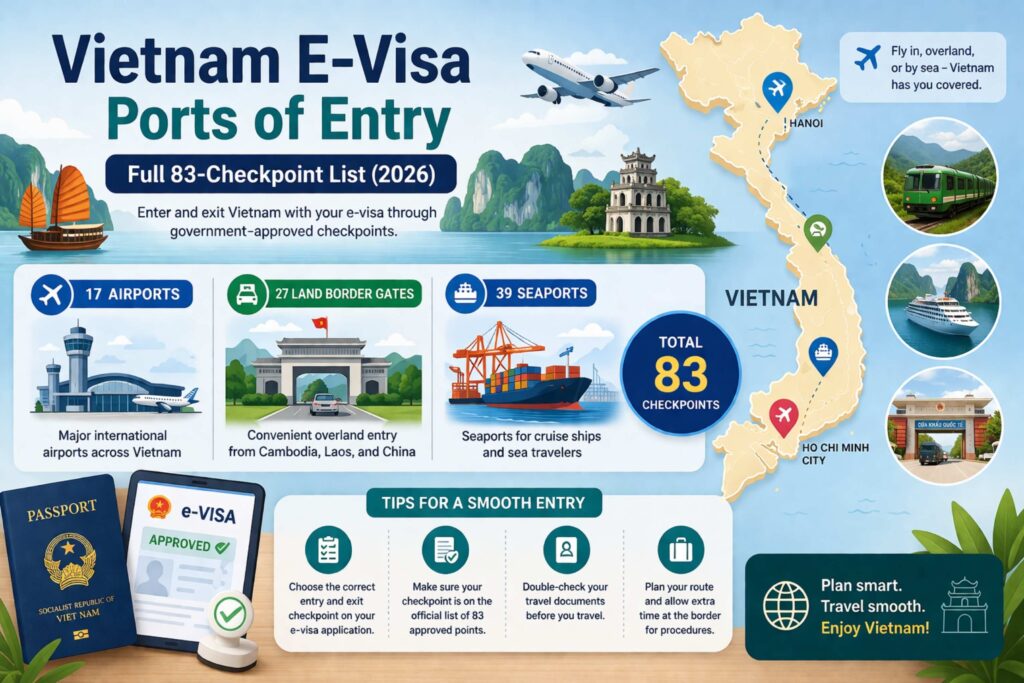
Travelers using an e-visa must enter and exit through the government-approved checkpoints listed by the Vietnam Immigration Department. As of the December 2025 expansion under Resolution 389/NQ-CP, the total number of approved e-visa checkpoints has increased to 83, including 17 airports, 27 land border gates, and 39 seaports.
In this guide, you’ll find the full updated list of Vietnam e-visa ports of entry, along with practical tips on how to choose the correct checkpoint on your application and avoid common mistakes.
What are Vietnam e-visa ports of entry?
Vietnam e-visa ports of entry are the official international checkpoints where foreign travelers are permitted to enter or leave Vietnam using a valid e-visa. According to the Vietnam Immigration Department, e-visas can only be used through the border gates approved by the Government.
This matters because the e-visa application form requires applicants to select both:
- their intended entry checkpoint
- and their intended exit checkpoint
So before you submit your application, it is important to make sure your airport, land border, or seaport is on the approved list.
How many Vietnam e-visa checkpoints are there in 2026?
As of the latest government update, Vietnam allows e-visa holders to use 83 checkpoints in total:
- 17 airports
- 27 land border gates
- 39 seaports
This expansion gives travelers much more flexibility, especially those entering Vietnam by land from Cambodia, Laos, or China, or by sea on cruise itineraries.
Full list of Vietnam e-visa airports
If you are flying into Vietnam, these are the airports currently approved for e-visa entry and exit:
- Noi Bai International Airport, Hanoi
- Tan Son Nhat International Airport, Ho Chi Minh City
- Da Nang International Airport, Da Nang
- Cam Ranh International Airport, Khanh Hoa Province
- Phu Quoc International Airport, Kien Giang Province
- Cat Bi International Airport, Hai Phong
- Can Tho International Airport, Can Tho
- Phu Bai International Airport, Hue
- Van Don International Airport, Quang Ninh Province
- Tho Xuan International Airport, Thanh Hoa Province
- Dong Hoi International Airport, Quang Binh Province
- Phu Cat International Airport, Binh Dinh Province
- Lien Khuong International Airport, Lam Dong Province
- Vinh International Airport, Nghe An Province
- Chu Lai International Airport, Quang Nam Province
- Long Thanh International Airport, Dong Nai Province (once officially operational)
- Gia Binh International Airport, Bac Ninh Province (once officially operational)
For most travelers, the most commonly used e-visa airports are:
- Noi Bai for Hanoi and Northern Vietnam
- Tan Son Nhat for Ho Chi Minh City and Southern Vietnam
- Da Nang for Central Vietnam
- Cam Ranh for Nha Trang
- Phu Quoc for Phu Quoc Island.
Full list of Vietnam e-visa land border
If you are entering Vietnam overland, these are the approved land border gates for e-visa holders:
- Bo Y International Border Gate, Kon Tum Province
- Cha Lo International Border Gate, Quang Binh Province
- Cau Treo International Border Gate, Ha Tinh Province
- Huu Nghi International Border Gate, Lang Son Province
- Ha Tien International Border Gate, Kien Giang Province
- Lao Bao International Border Gate, Quang Tri Province
- Lao Cai International Border Gate, Lao Cai Province
- La Lay International Border Gate, Quang Tri Province
- Moc Bai International Border Gate, Tay Ninh Province
- Mong Cai International Border Gate, Quang Ninh Province
- Nam Can International Border Gate, Nghe An Province
- Na Meo International Border Gate, Thanh Hoa Province
- Vinh Xuong International Land and River Border Gate, An Giang Province
- Tinh Bien International Border Gate, An Giang Province
- Tay Trang International Border Gate, Dien Bien Province
- Xa Mat International Border Gate, Tay Ninh Province
- Dong Dang Border Gate (Railway), Lang Son Province
- Lao Cai Border Gate (Railway), Lao Cai Province
- Tra Linh Border Gate, Cao Bang Province
- Long Sap Border Gate, Son La Province
- Nam Giang Border Gate, Da Nang City
- Le Thanh Border Gate, Gia Lai Province
- Binh Hiep Border Gate, Tay Ninh Province
- Thuong Phuoc Land and Waterway Border Gate, Dong Thap Province
- Dinh Ba International Border Gate, Dong Thap Province
- Tan Nam International Border Gate, Tay Ninh Province
- Thanh Thuy International Border Gate, Tuyen Quang Province
These checkpoints are especially useful for travelers combining Vietnam with neighboring countries such as Cambodia, Laos, and China. Popular overland routes include Moc Bai, Ha Tien, Huu Nghi, and Lao Cai, depending on your itinerary.
Full list of Vietnam e-visa seaports
Traveling by cruise or sea? Vietnam also permits e-visa entry and exit through 39 approved seaports.
Previously approved seaports
- Chan May Port Border Gate, Thua Thien Hue Province
- Cam Pha Port Border Gate, Quang Ninh Province
- Da Nang Port Border Gate, Da Nang City
- Duong Dong Port Border Gate, Kien Giang Province
- Dung Quat Port Border Gate, Quang Ngai Province
- Hon Gai Port Border Gate, Quang Ninh Province
- Hai Phong Port Border Gate, Hai Phong City
- Nghi Son Port Border Gate, Thanh Hoa Province
- Nha Trang Port Border Gate, Khanh Hoa Province
- Quy Nhon Port Border Gate, Binh Dinh Province
- Ho Chi Minh City Port Border Gate, Ho Chi Minh City
- Vung Ang Port Border Gate, Ha Tinh Province
- Vung Tau Port Border Gate, Ba Ria-Vung Tau Province
Additional seaports added under Resolution 389/NQ-CP
- Van Gia Seaport, Quang Ninh Province
- Diem Dien Seaport, Hung Yen Province
- Hai Thinh Seaport, Ninh Binh Province
- Ninh Binh Seaport, Ninh Binh Province
- Cua Lo – Ben Thuy Seaport, Nghe An Province
- Son Duong Seaport, Ha Tinh Province
- Giang Seaport, Quang Tri Province
- Hon La Seaport, Quang Tri Province
- Cuu Viet Seaport, Quang Tri Province
- Thuan An Seaport, Hue City
- Ky Ha Seaport, Da Nang City
- Sa Ky Seaport, Quang Ngai Province
- Vung Ro Seaport, Dak Lak Province
- Ca Na Seaport, Khanh Hoa Province
- Ninh Chu Seaport, Khanh Hoa Province
- Phu Quy Seaport, Lam Dong Province
- Lien Huong Seaport, Lam Dong Province
- Ben Luc Seaport, Tay Ninh Province
- Dong Thap Seaport, Dong Thap Province
- Soai Rap – Hiep Phuoc Seaport, Dong Thap Province
- My Thoi Seaport, An Giang Province
- Hon Chong Seaport, An Giang Province
- An Thoi Seaport, An Giang Province
- Truong Long Hoa Seaport, Vinh Long Province
- Giao Long Seaport, Vinh Long Province
- Nam Can Seaport, Ca Mau Province
If you are arriving on a cruise, it is worth confirming the exact port listed on your itinerary, not just the city or region.
How to choose the correct port of entry on your Vietnam e-visa application
On the official Vietnam e-visa application form, applicants must provide:
- intended date of entry
- allowed entry through checkpoint
- exit through checkpoint
Here are a few best practices:
1. Match your actual arrival point
Choose the checkpoint where you will physically enter Vietnam, not your final destination.
For example:
- If you land in Ho Chi Minh City, choose Tan Son Nhat
- If you enter from Cambodia by bus, choose the actual border gate such as Moc Bai
- If you arrive by cruise, select the specific approved seaport on your itinerary.
2. Check the official spelling carefully
Checkpoint names can look similar, especially with land and sea entries. It is best to use the name as shown on the official system or cross-check it against the government list.
3. Do not assume every airport is eligible
Vietnam has many airports and ports, but e-visas are valid only at the approved checkpoints.
4. Be careful with future airports
Long Thanh and Gia Binh are listed as e-visa airports only once they officially begin operation. Travelers should not choose them unless they are already active and available in the official system at the time of application.
Can you enter Vietnam through a different checkpoint than the one on your application?
Because the official e-visa form requires applicants to select both an intended entry and exit checkpoint, it is safest to assume that these details should match your real travel plan as closely as possible.
If your itinerary changes after approval, do not rely on informal advice online. Instead, check the official portal or seek proper support before traveling. This is especially important for land borders and cruise arrivals, where checkpoint differences may be more significant.
Common mistakes travelers make
Choosing the wrong checkpoint is one of the easiest ways to create unnecessary problems with a Vietnam e-visa. Here are some common mistakes to avoid:
Selecting the wrong airport
Some travelers choose Hanoi or Ho Chi Minh City by habit, even though they are actually arriving somewhere else. Always match your first Vietnam arrival point.
Assuming all land borders are approved
Vietnam has many border crossings, but only the approved ones can be used with an e-visa.
Forgetting that cruises need approved seaports too
If you are arriving by cruise ship, your seaport must also be on the e-visa list.
Confusing visa validity with checkpoint eligibility
Vietnam e-visas can be valid for up to 90 days, with single-entry or multiple-entry options, but that does not mean they can be used at any port. Checkpoint restrictions still apply.
Get stuck in applying e-visa? evisas vietnam can help you HERE
Vietnam e-visa validity at a glance
According to the Vietnam Immigration Department, Vietnam e-visas are valid for up to 90 days and may be issued as single-entry or multiple-entry visas. The official portal also states that the e-visa fee is USD 25 for single-entry and USD 50 for multiple-entry, and the fee is not refunded if the application is refused.
That makes it even more important to submit accurate information the first time, including your intended checkpoints.
Quick checklist before you apply
Before you submit your Vietnam e-visa application, make sure you have checked all of the following:
- Your arrival airport, land border, or seaport is on the approved list
- Your intended entry checkpoint is selected correctly
- Your intended exit checkpoint is selected correctly
- Your visa type matches your trip length and number of entries
- Your itinerary is unlikely to change after application.
Final thoughts
Vietnam’s e-visa system is much more flexible than before, with 83 approved checkpoints now available across airports, land borders, and seaports.
The proper approach is to verify your exact entry and exit points before applying and make sure they match the government-approved list.
If you get that step right, the rest of the process becomes much smoother.
- If you are checking whether you even need a visa, read Vietnam Visa Exemption 2026: Who Can Enter Free (And When You Need an E-Visa)
- If you plan to apply for e-visa, check it out here to get approved in as little as 1 hour: Start Your Application