Applying for a Vietnam e-visa is a simple process, but it is not one where small mistakes go unnoticed. A typo in your passport number, a mismatched travel date, or a photo that does not meet the requirements can all lead to delays or rejection. Since the government fee is non-refundable, even a minor error can mean losing time, missing your planned schedule, and paying again to reapply.
This guide explains the most common Vietnam e-visa mistakes that cause delays, why they happen, and how to avoid them before you submit your application.

Mistake 1. Passport and Personal Detail Errors
Incorrect personal details are the single most common reason Vietnam e-visa applications get stuck in processing. The system cross-references what you type against your uploaded passport scan, and any mismatch triggers a manual review or outright rejection.
- Name Mismatches
Your name on the application must match the Machine Readable Zone (MRZ) at the bottom of your passport bio-data page, character for character. Not the name you use day to day. Not the shortened version on your boarding pass. The MRZ.
This trips up travelers who have middle names, hyphenated surnames, suffixes, or names that were transliterated differently across documents. If your MRZ reads SMITH<<JOHN<ROBERT, your application must include John Robert Smith, not John Smith.
For a full breakdown of how to read and match your MRZ correctly, see the Vietnam E-Visa Passport Scan Requirements guide on the evisas vietnam blog.
- Wrong Passport Number or Expiry Date
A single transposed digit in your passport number will get the application returned. The same applies to the expiry date. Your passport must also be valid for at least six months beyond your intended arrival date in Vietnam. If it expires sooner, the application will be refused regardless of how accurate everything else is.
- Using Details from an Old Passport
If you recently renewed your passport, double-check that you are entering details from the new document. Entering old passport data is more common than you might expect, and even if the e-visa is somehow issued against the wrong passport, it will be useless at the immigration counter.
Mistake 2. Photo and Document Upload Errors
Photo problems are the second biggest cause of processing delays. The Vietnam e-visa application requires two separate image uploads: a portrait photo and a scan of your passport bio-data page. Each has strict requirements, and uploading the wrong file for either one will stall your application.
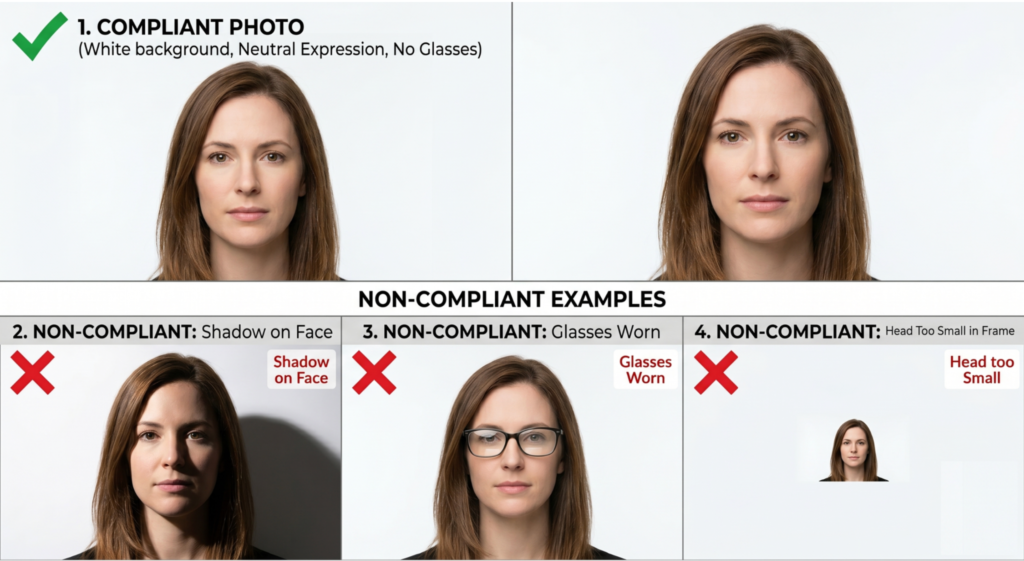
- Portrait Photo Mistakes
The portrait photo must meet these specifications:
| Requirement | Specification |
| Size | 4 x 6 cm |
| File format | JPG or JPEG only |
| Max file size | 1 MB (safe target) |
| Background | Plain white |
| Expression | Neutral, mouth closed, eyes open |
| Glasses | Not permitted (including prescription) |
| Headwear | Not permitted (religious exceptions apply) |
The most frequent mistakes: using a photo with a coloured or patterned background, submitting a PNG or PDF instead of JPG, and uploading a cropped casual photo instead of a purpose-taken portrait. For the full list of specifications and how to take a compliant photo at home, read the Vietnam E-Visa Photo Requirements (2026): The Complete Guide.
- Passport Scan Mistakes
The second upload is a scan or photo of your passport bio-data page. This is where many applicants upload the passport cover instead of the data page. Others submit images that are tilted, cropped at the corners, or too dark to read.
The ICAO lines (the two rows of machine-readable text at the bottom of your bio page) must be fully visible and legible. If they are cut off, blurry, or obscured by glare, the application will be returned. The Vietnam E-Visa Passport Scan Requirements article covers every detail of what a compliant scan looks like.
Pro Tip: Do not upload the same image for both the portrait and passport scan fields. The system flags duplicate uploads and returns the application.
Mistake 3. The Date Format Errors
Vietnam uses DD/MM/YYYY. The United States and several other countries use MM/DD/YYYY. Swapping the month and day is one of the most common reasons travelers receive an e-visa with the wrong validity dates, or get denied boarding at the airport.
This applies to every date field on the application: date of birth, intended arrival date, and intended departure date. If you enter 05/03/2026 meaning March 5th but the system reads it as May 3rd, your visa validity window will be wrong. You may not notice until check-in.
Check every date field twice before submitting. Confirm the day and month are in the correct position for the DD/MM/YYYY format.
Mistake 4. Incorrect or Incomplete Travel Details
- Missing or Wrong Accommodation Address
The application asks for your temporary address in Vietnam, including the ward or commune. This field confuses many travelers because Vietnamese administrative divisions are unfamiliar. If you are unsure, copy the full address from your hotel booking confirmation and check with the hotel which ward they are registered under.
Do not leave this field blank or guess. An incomplete address is a common reason for applications to be held for additional review.
- Choosing the Wrong Entry Type
Selecting single entry when you need multiple entry (or the other way around) can create serious problems mid-trip. A single entry visa becomes void the moment you leave Vietnam, even if you have 60 days of validity remaining. If you have any plans to cross into Cambodia, Laos, or Thailand during your trip, you need multiple entry.
For a detailed comparison of what each option covers, see Single vs. Multiple Entry Vietnam E-Visa: Which One Do You Need? on the evisas vietnam blog.
Mistake 5. Not Checking Your Application Status
The Vietnam e-visa system does not send email notifications when your visa is approved. It also does not email you if there is a problem with your application.
You must actively check your status on The Official Portal using your registration code, email address, and date of birth.
If the Vietnam Immigration Department requests a correction (a new photo, a clarification on your name), that request only appears on the status page. If you do not check and respond promptly, your application may sit in limbo until it expires. Check your status daily starting from day three after submission.
Mistake 6. Applying Too Late or During Vietnamese Public Holidays
Standard e-visa processing takes up to three working days, but it can extend to 15 working days during busy periods or when the application requires amendments. If you submit your application the week before your flight, you are cutting it dangerously close.
Vietnamese public holidays add another layer of risk. Government offices do not process applications on these days, and the backlog after a holiday cluster can push processing times well beyond the standard window.
Key 2026 Vietnamese holidays that affect e-visa processing:
| Holiday | Dates |
| Hung Kings Commemoration Day | April 26 |
| Reunification Day + Labour Day | April 30 – May 3 |
| National Day | September 2 – 3 |
| Tet (Lunar New Year) 2027 | Late January (dates vary) |
Pro Tip: Vietnam holiday periods can slow things down. Apply early with evisas vietnam Holiday Package for a smoother experience.
For the full list of public holidays, learn more here.
Mistake 7. The Children Field That Catches Parents Off Guard
The e-visa application includes a field for children under 14 who are included in your passport. This field is only relevant if your child’s name is physically printed inside your passport. If your child has their own separate passport, they need their own separate e-visa application.
The mistake: parents with children who hold independent passports add them to the parent’s application. When the e-visa is issued, the child’s name appears on the parent’s visa document but not in the parent’s passport. The child is left with no valid visa and cannot board the flight.
Always apply separately for children who hold their own passports.
What to Do If Your Application Is Already Delayed
If your application has been in processing for more than seven working days, here are your options:
- Check your status at evisa.gov.vn using your registration code, email, and date of birth. Look for any correction requests.
- If there is a correction request, respond immediately with the updated information or photo.
- If there is no update and your travel date is approaching, consider reapplying through an expedited service. evisas vietnam offers rush processing that can deliver an approved e-visa in as little as one hour during business hours. See the Emergency Vietnam E-Visa Guide for details.
Do not submit a second application while the first one is still active. Vietnam’s immigration system flags overlapping applications, and both can be suspended.
Get It Right Before You Submit
Every mistake on this list is preventable. A careful review of your passport details, dates, photos, and travel information before you submit is the difference between a smooth approval and a stalled application.
If you want a second set of eyes on your application, evisas vietnam’s team reviews every submission before it reaches the Vietnam Immigration Department. The manual review process catches name mismatches, date format errors, photo problems, and document issues before they become a delay.
All final visa decisions are issued by the Vietnam Immigration Department, evisas vietnam provides application support and expert review to help you apply accurately.
Ready to apply? Start your Vietnam e-visa application with evisas vietnam.