
Vietnam E-Visa Validity Explained: Entry Date, Exit Date, and Stay Period
You applied for your Vietnam e-visa, got the approval email, and opened the PDF. Now you’re looking at a block of Vietnamese text, a set of dates, and wondering: how exactly does this work?
The dates on your e-visa are not suggestions. They are the hard boundaries of your trip. Enter before the first date, and you will be turned away. Stay past the last date, and you are breaking Vietnamese immigration law. Understanding what each date means, and how they interact, is the single most important thing you can do before boarding your flight.
This guide breaks down every date on your Vietnam e-visa in plain language: what they mean, how the stay period is calculated, and what to do if your plans change after the visa is issued.
What “Validity” Actually Means on a Vietnam E-Visa
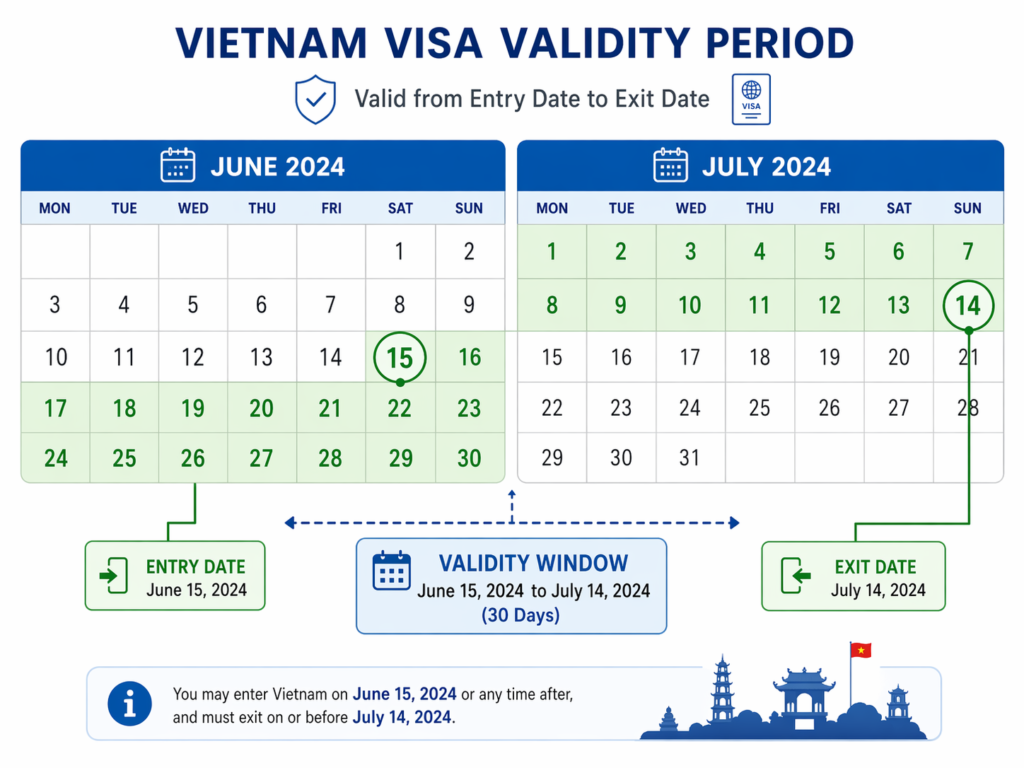
The validity period is the window of time between the entry date and the exit date printed on your e-visa document. These two dates define when you are allowed to be in Vietnam.
Both dates are set at the time of application, based on what you enter in the form. Once the visa is issued by the Vietnam Immigration Department, these dates are locked. They cannot be edited, extended, or shifted.
One important distinction: validity and length of stay are not always the same thing.
- Validity is the window during which you may enter and must exit.
- Length of stay is the number of days you actually spend in the country.
If you enter late, your length of stay shrinks, but the exit date stays exactly where it is.
Understanding the Dates on Your Vietnam E-Visa
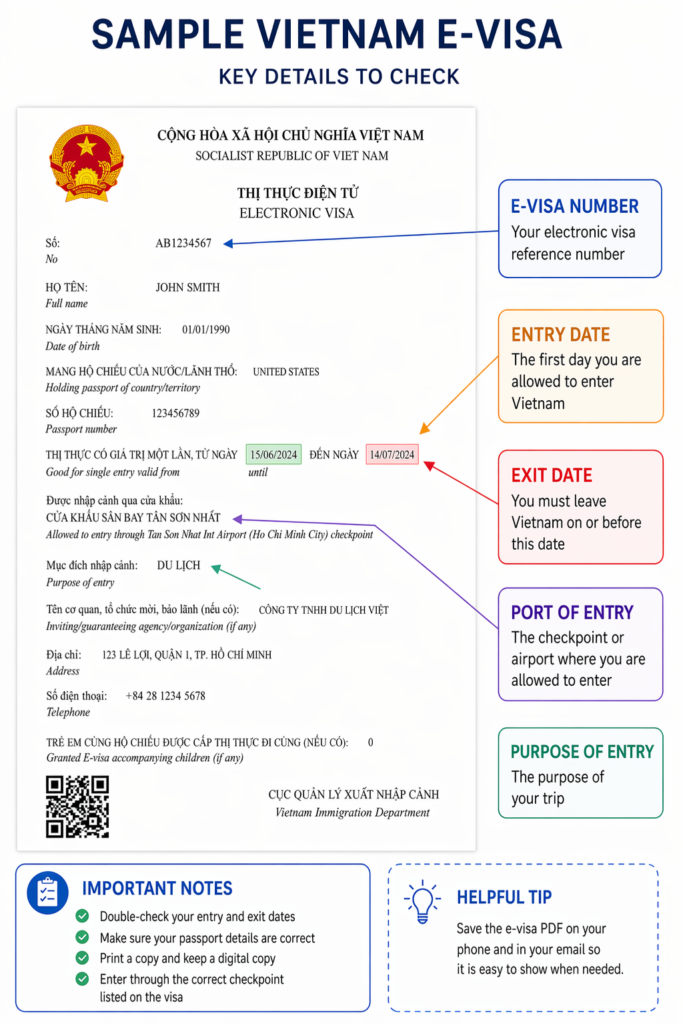
Every approved Vietnam e-visa PDF contains the same core information. The dates appear in Vietnamese, and here is what each one means.
Entry Date
This is the earliest date you are allowed to enter Vietnam. You can arrive on this date or any date after it, up to and including the exit date.
You cannot enter before this date, even by one day. Airlines and immigration officers check this, and you may be denied boarding or turned back at the border if your arrival falls before the valid-from date.
Exit Date
This is the last day you are legally permitted to be in Vietnam. You must physically leave the country by midnight on this date.
Leaving earlier is fine. There is no penalty for departing before your exit date. But staying even one day beyond it is classified as an overstay, which carries fines and potentially more serious consequences.
How Your Allowed Stay Is Calculated
The stay period is the total number of calendar days between your entry date and exit date, inclusive of both. It is not calculated from the day you physically arrive. It is fixed to the dates on the visa.
For a 30-day single entry e-visa: the exit date falls 29 calendar days after the entry date (because both the first and last day count).
For a 90-day e-visa: the exit date falls 89 calendar days after the entry date.
The key takeaway: if you arrive five days after your entry date, you do not get five extra days at the end. Your exit date has not moved.
How the Validity Window Works in Practice
The best way to understand the validity window is through examples. The table below shows how the dates play out for two common visa durations.
| Scenario | Entry Date | Exit Date | What Happens |
| 30-day visa, arrive on entry date | 01/07/2026 | 30/07/2026 | Full 30 days in Vietnam. Must depart by 30 July. |
| 30-day visa, arrive 5 days late | 01/07/2026 | 30/07/2026 | Only 25 days in Vietnam. Exit date is still 30 July. |
| 90-day visa, arrive on entry date | 01/07/2026 | 28/09/2026 | Full 90 days. Must depart by 28 September. |
| 90-day visa, arrive 2 weeks late | 01/07/2026 | 28/09/2026 | Only 76 days in Vietnam. Exit date unchanged. |
Important: Vietnam uses the DD/MM/YYYY date format. Travelers from the United States and other countries that use MM/DD/YYYY should double-check every date carefully. Confusing 05/07/2026 (5 July) with 07/05/2026 (7 May) is one of the most common application errors.
Single Entry vs. Multiple Entry: How Validity Differs
The validity window applies to both single and multiple entry visas, but how it works after your first entry is different.
Single entry: The visa is valid for one entry and one exit. Once you leave Vietnam, the visa is void, even if your exit date has not passed yet. If you want to return, you need a new visa.
Multiple entry: The visa stays active for the entire validity window. You can exit and re-enter Vietnam as many times as you need before the exit date. Each re-entry does not reset the clock. The exit date on your visa remains the final day you can be in the country.
One rule applies to all e-visas: your first entry must be at the port declared on your application. After that initial entry, subsequent entries (on a multiple entry visa) can use any of the 83 approved international checkpoints by land, air, or sea.
For a detailed comparison of the two options, see the single vs. multiple entry Vietnam e-visa guide on the evisas vietnam blog.
Five Common Date Mistakes (and How to Avoid Them)
Most date-related visa problems are avoidable. These are the five that come up most often.
- Entering dates in the wrong format. The Vietnam e-visa portal uses DD/MM/YYYY. Travelers who are used to MM/DD/YYYY sometimes swap the month and day without realising it. This can result in a visa that starts or ends on the wrong date entirely. Always verify the month and day before submitting.
- Arriving before the entry date. If your flight lands before the valid-from date on your e-visa, you will not be allowed to enter Vietnam. Airlines may also deny boarding. There is no grace period.
- Assuming a late arrival extends the exit date. It does not. If your visa runs from 1 July to 30 July and you arrive on 10 July, your exit date is still 30 July. You get 20 days in Vietnam, not 30.
- Requesting fewer days than needed. The validity period is defined by the dates you enter on the application form. If you request a 30-day window but your trip is 45 days, the visa will not cover your stay. Set the dates to match your full travel plan from the start.
- Applying for a new e-visa while the current one is still active. Submitting a new application before your existing visa has expired or been used can create a conflict in the immigration system. In some cases, both visas may be suspended. If you need to change dates, wait until the current visa expires or complete your trip first.

What Happens If Your Travel Dates Change After the Visa Is Issued
Once a Vietnam e-visa has been approved and the PDF is generated, the information is locked. There is no way to edit the entry date, exit date, or any other field on the document.
If your plans change, here is what to do:
- Flight moves earlier than the entry date: You need to apply for a new e-visa with updated dates. The old visa becomes invalid once the new one is issued.
- Flight moves later than the exit date: Same solution. Apply for a new visa that covers the extended dates.
- Flight moves to a different date within the existing validity window: No action needed. Your visa already covers that date.
Pro Tip: Many experienced travelers set their entry date a few days earlier than their planned arrival and request the full 90-day validity window. This builds in flexibility if flights change, without needing to reapply. You can always enter later than the entry date or leave earlier than the exit date with no consequences.
Overstaying Your Exit Date: What You Risk
Staying in Vietnam past the exit date on your e-visa is a violation of immigration law. Even one day counts.
Under Decree 282/2025, which took effect on 15 December 2025, Vietnam significantly increased the penalties for overstays. Fines are based on the length of the overstay:
| Overstay Duration | Fine Range |
| 1 to 15 days | VND 500,000 to VND 2,000,000 |
| 16 to 29 days | VND 5,000,000 to VND 10,000,000 |
| 30 to 59 days | VND 5,000,000 to VND 15,000,000 |
| 60 days to under 6 months | VND 15,000,000 to VND 25,000,000 |
| 6 months to under 12 months | VND 25,000,000 to VND 30,000,000 |
| 12 months or more | Up to VND 40,000,000 |
Beyond fines, overstays of 16 days or more may result in deportation under Decree 59/2026, which took effect on 1 April 2026. Severe or repeated violations can lead to blacklisting and a multi-year ban on re-entering Vietnam.
The simplest way to avoid an overstay is to get the dates right at the application stage. Having a second set of eyes review your entry and exit dates before submission catches the kind of small errors that lead to serious problems at the border.
Frequently Asked Questions
Can I enter Vietnam after my entry date?
Yes. You can enter on the entry date or any day after it, as long as it is on or before the exit date. Arriving after the entry date does not extend your exit date.
Can I leave Vietnam before my exit date?
Yes. There is no penalty for departing early. You can leave at any time before the exit date.
Can I extend my e-visa from inside Vietnam?
Vietnam e-visas currently cannot be extended. If you need to stay longer, you would need to exit the country and apply for a new e-visa. This is commonly known as a visa run.
How far in advance can I apply for an e-visa?
You can submit your application up to 12 months before your intended entry date. Applying early gives you time to correct any issues before your trip.
Does a domestic flight within Vietnam count as an exit?
No. Flying between Vietnamese cities (for example, Hanoi to Ho Chi Minh City, or Da Nang to Phu Quoc) does not count as leaving the country. Your e-visa remains valid throughout.
What if the immigration officer stamps a different exit date?
In some cases, the immigration officer at the port of entry may stamp an exit date in your passport that differs from your e-visa. The stamped date in your passport is the one you must follow. Check the stamp immediately after entry and contact local immigration if there is a discrepancy.
Get the Dates Right the First Time
The dates on your Vietnam e-visa are the hardest boundaries of your trip. They determine when you can arrive, how long you can stay, and when you must leave. Every other part of your travel plan, including flights, hotels, and itineraries, needs to fit within that window.
Getting those dates right at the application stage is straightforward when you know what each field means. But a small error, like swapping the month and day, or requesting a 30-day window when you need 45, can turn a smooth trip into an expensive problem.
evisas vietnam’s team reviews every application before it is submitted to the Vietnam Immigration Department. That includes checking your entry and exit dates against your travel plans, flagging potential format errors, and making sure the validity window covers your full trip. All final visa decisions are issued by the Vietnam Immigration Department.
Start your Vietnam e-visa application with evisas vietnam and get it right the first time.